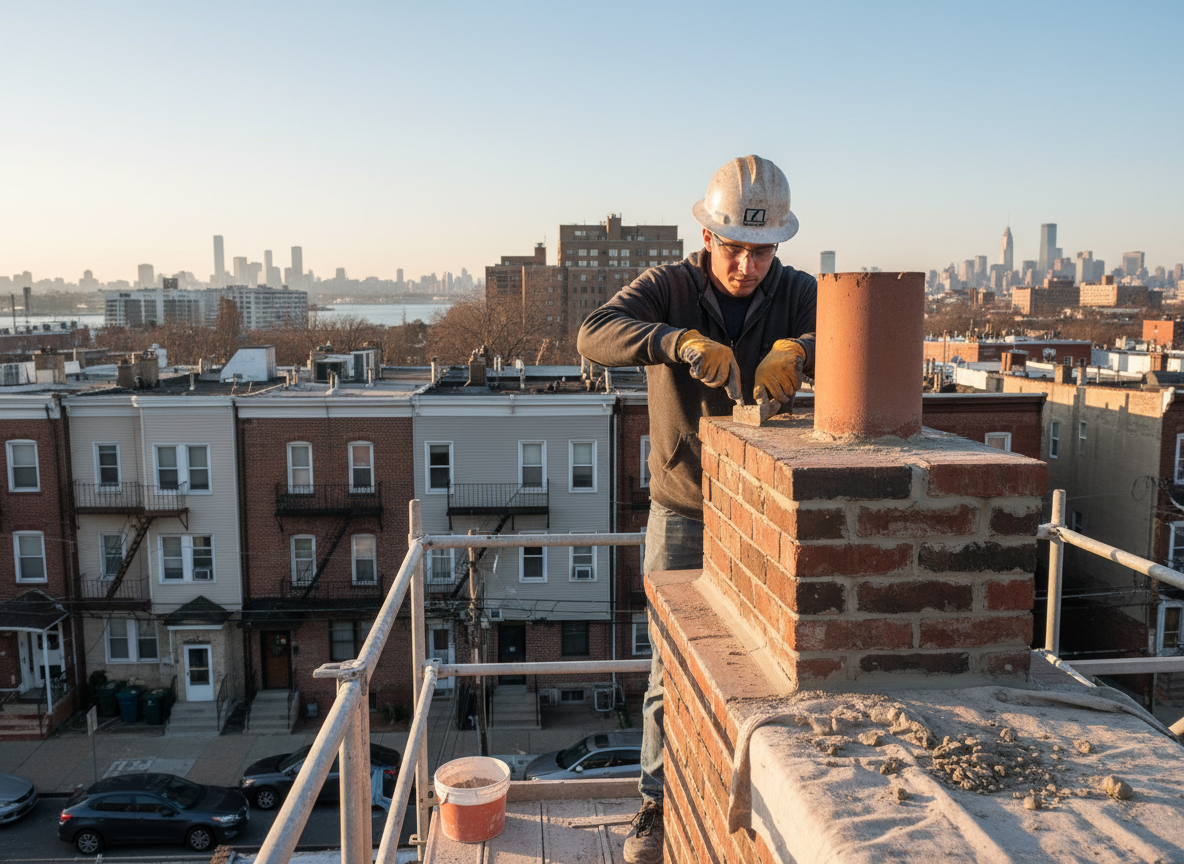
Chimney tuckpointing in Hudson County requires matching the original lime-based mortar found in early 1900s brickwork common throughout Downtown West New York and The Heights. Modern Portland cement mixes shrink differently and trap moisture against the flue liner, accelerating spalling when temperatures swing from humid subtropical summers into cold winters. Proper depth removal of failed mortar, usually three-quarters of an inch, prevents water from sitting in the joints near the Hudson River Waterfront where constant humidity keeps the brick damp longer than inland areas.
Access challenges appear quickly on homes along the steep slopes near North Hudson Park or close to Union City and North Bergen borders. Scaffolding must account for narrow lots and shared walls, while wind off the waterfront can cool fresh mortar too fast and weaken the bond. We test existing mortar hardness on site because many West New York chimneys still carry the softer historic mix that cannot tolerate power tools without cracking surrounding brick.
Edge cases include chimneys that have received prior cement patches which must be fully cut out before new work begins. Failure to do so creates hard spots that expand at different rates during winter freezes and reopen cracks within one season. We also check for flue liner gaps that allow exhaust to push moisture outward, a frequent issue in older Hudson County stock where tuckpointing alone will not solve the underlying draft problem.
Winter Preparation
Tuckpointing performed before the first hard freeze gives the mortar time to cure while temperatures remain above fifty degrees. Waiting until spring means another full winter of water infiltration through open joints, especially on north-facing chimneys that never fully dry between storms.
Technician insight
In West New York, the thing that catches most people out with chimney tuckpointing is how quickly the Hudson River humidity keeps north-facing joints wet through the cold months. Homes in The Heights and Downtown West New York still carry the original soft lime mortar that freezes and crumbles faster than newer cement repairs. Homeowners often try to patch only the visible spots with hardware-store caulk, which seals moisture inside and forces the next round of tuckpointing to remove twice as much material.
Tuckpointing After Winter Damage in The Heights
A chimney on a 1920s row house in The Heights showed open joints on the north side after repeated freeze-thaw cycles. We found river humidity had kept the mortar saturated long enough for ice to push the joints apart. We removed the failed material, repointed with a matching lime mix, and dressed the crown to shed water. The homeowner reported no further spalling the following spring.
How it works
- 1
Site Assessment
Inspect mortar condition, brick age, and exposure to river moisture from ground level and roof.
- 2
Mortar Removal
Cut out failed joints to consistent depth without damaging original brick faces.
- 3
Joint Cleaning
Flush debris and dust, then dampen brick to control suction before new mortar application.
- 4
Repointing
Pack fresh lime-based mortar in layers and tool to match existing profile for water shedding.
- 5
Curing Check
Protect fresh work from rapid drying or freezing for the first 48 hours.
Pricing
Cost depends on chimney height, number of sides accessible, and how much prior cement work must be removed first; we provide upfront quotes after inspection.