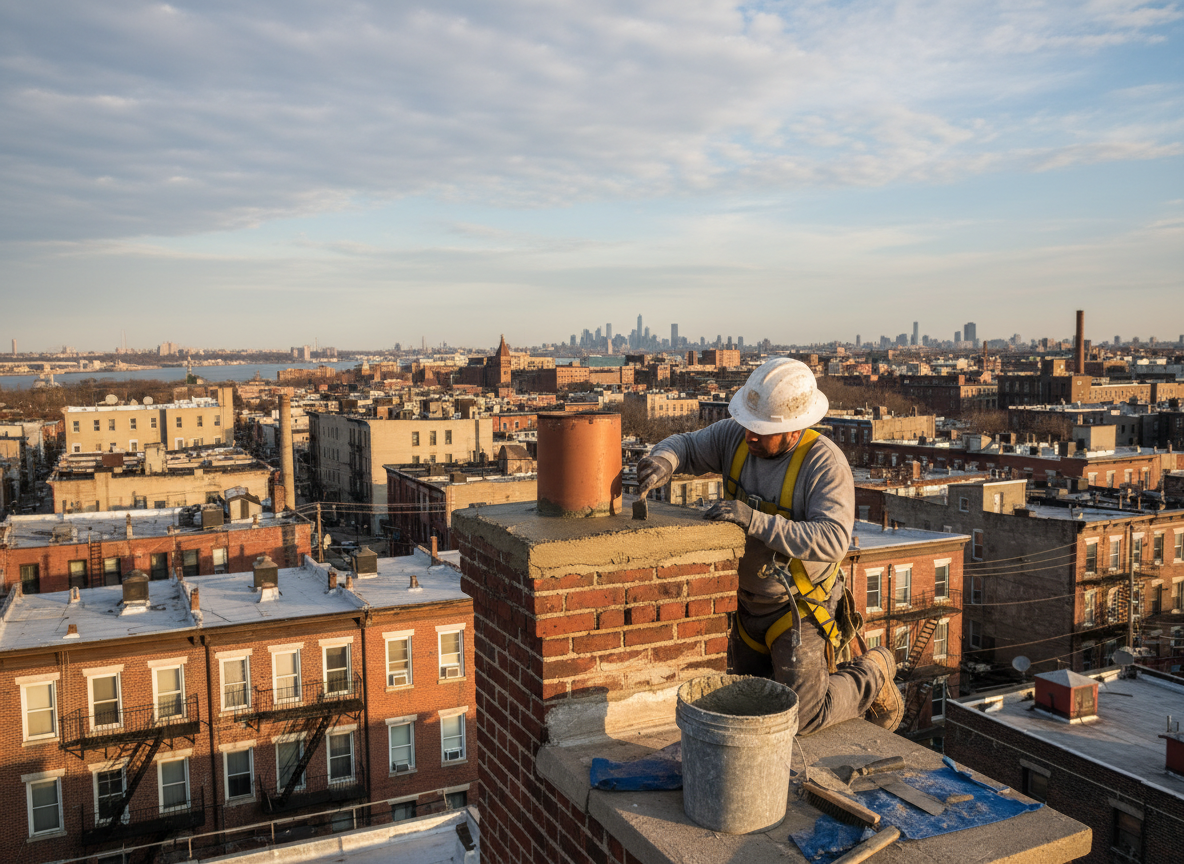
Chimney crowns in West New York take constant punishment from the humid subtropical climate, where hot summers drive expansion and cold winters trigger repeated freeze-thaw cycles that crack concrete and allow water to reach flue liners. Homes in The Heights and Downtown often date to the early 1900s with original clay-tile or brick construction that sits close to the Hudson River Waterfront, so moisture from fog and wind-driven rain accelerates spalling at the crown edges. We use a 1:3 Portland cement to sand mix with acrylic fortifier and stainless-steel lath reinforcement to match the thermal movement of older masonry while meeting Hudson County wind-load expectations.
Edge cases we see regularly include crowns poured directly over terra-cotta flue tiles without proper flashing, which lets water migrate into The Heights row-house attics during nor'easters. North Bergen and Union City properties with shared party walls add another complication: any crown work must stop short of the neighbor's flue to avoid code violations. We always remove the old crown in sections, inspect the flue tile tops for spalling, and install a new 2-inch overhang with a drip edge so runoff clears the brick rather than soaking the chimney face.
Before any repair we check for existing permits required by West New York building department when the crown change alters the chimney's exterior profile. We also verify the flue is clear and the chimney is plumb, because settling along the Hudson River Waterfront can tilt crowns and create hidden voids that standard patch jobs miss. The result is a monolithic crown that sheds water instead of trapping it, protecting the home through another winter of freeze-thaw stress.
Technician insight
In West New York, the thing that catches most people out with chimney crown repair is how the older brick in The Heights has already settled toward the river side, so a crown that looks level from the street is actually pitched to trap water against the back wall. We see this every winter after the first hard freeze.
Cracked Crown on The Heights Row House
Water was staining the attic ceiling after every rain. We found the original crown had multiple through-cracks and no overhang, letting runoff run straight down the flue. We removed the crown, added proper lath and a 2-inch drip edge, then poured a new monolithic top that matched the adjacent chimney height.
How it works
- 1
On-Site Inspection
We examine the crown from the roof and interior flue, checking for cracks, spalling, and water staining in homes across The Heights and Downtown West New York.
- 2
Old Crown Removal
We cut and remove the damaged crown in controlled sections, protecting surrounding brick and flashing on properties near North Hudson Park.
- 3
Flue and Base Prep
We clean the flue tops, install new stainless lath, and apply bonding agent to ensure the new crown adheres to older Hudson County masonry.
- 4
New Crown Pour and Cure
We form and pour a reinforced concrete crown with drip edge, then allow proper curing time before returning the chimney to service.
Pricing
Upfront written estimates after inspection; final price depends on crown size, extent of underlying flue damage, and access on multi-story homes near the Hudson River Waterfront.