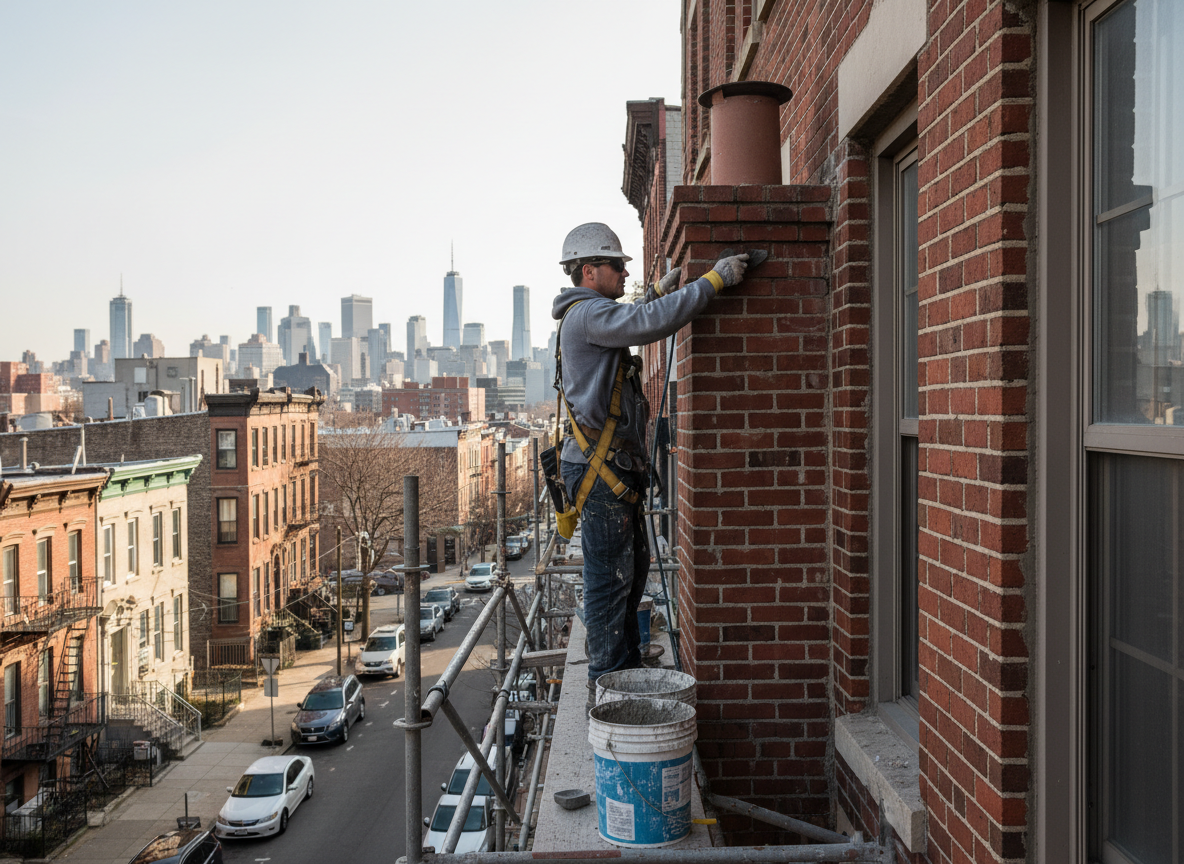
West New York sits in a humid subtropical zone where hot summers give way to cold winters that drive repeated freeze-thaw cycles against brick and masonry chimneys. Homes in Downtown West New York and The Heights are often early-20th-century row houses with common-wall flues that shift when the ground near the Hudson River Waterfront expands and contracts. These movements open mortar joints and let water enter, accelerating spalling on the exterior and creosote buildup inside the flue during the heating season.
Hudson County properties near North Hudson Park frequently back up to steep slopes where runoff channels toward foundations and chimneys. That constant moisture, combined with salt air from the river, corrodes flue liners and crown caps faster than in inland towns like Union City or North Bergen. A repair here usually requires removing loose brick, installing stainless-steel liners rated for the local temperature swings, and repointing with type-N mortar that matches the original lime content so the stack can still breathe.
Because many chimneys share walls with neighboring units, any repair must respect fire-code separation requirements that inspectors in West New York enforce strictly. Skipping proper parging or using the wrong flue size can push exhaust into an adjacent home. Owner-operated crews from 55-1 Riverwalk Pl respond 24/7 to these issues because a blocked or cracked flue during a January cold snap leaves residents without heat and risks carbon-monoxide migration through shared masonry.
Technician insight
In West New York, the thing that catches most people out with chimney repair is how the steep slopes behind North Hudson Park funnel rainwater straight into the base of shared-wall chimneys. Homeowners in The Heights often assume a new cap will fix draft issues, but the real problem is usually cracked parging hidden behind the common brick that only shows up on a camera after a freeze cycle.
Shared-Wall Flue Leak in The Heights
A homeowner in a 1920s row house reported water stains on the second-floor ceiling after a cold snap. Inspection found failed crown mortar and a cracked clay liner allowing runoff from the slope behind North Hudson Park to enter the shared flue. The crew removed the damaged sections, installed a stainless-steel liner sized for the two-story stack, and repointed with lime mortar compatible with the original brick. Draft and separation tests passed inspection, restoring safe use before the next freeze.
How it works
- 1
Initial Assessment
Technician climbs to the roof from the Riverwalk Pl base and inspects crown, flashing, and flue condition while noting shared-wall constraints common in The Heights.
- 2
Diagnosis and Quote
Camera scan reveals cracks or liner damage; homeowner receives a written scope that factors in slope runoff and winter freeze exposure before any work begins.
- 3
Repair Execution
Crew removes failed masonry, installs new liner, repoints joints, and reseals flashing using materials suited to Hudson River humidity and salt exposure.
- 4
Final Verification
Second camera pass and smoke test confirm draft and separation from neighboring units; property is left broom-clean with 24/7 contact for follow-up.
Pricing
Pricing reflects chimney height, liner type, and extent of masonry damage; most Hudson County jobs fall into predictable ranges once the flue is scoped.